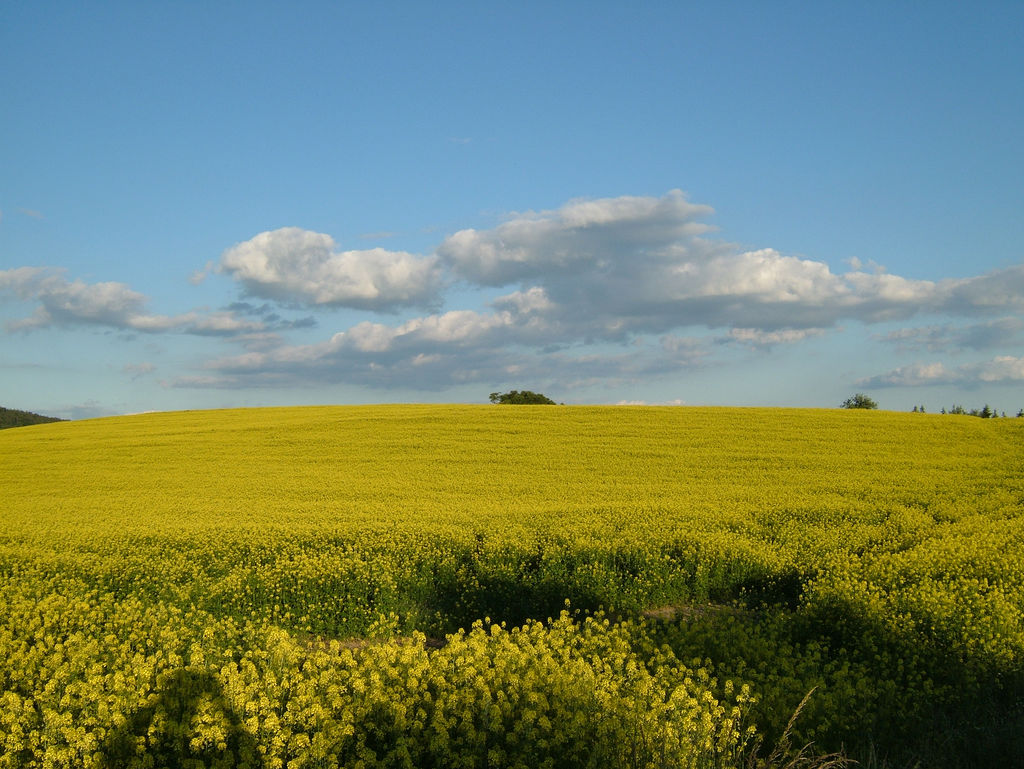
Photo by snopek on Flickr
Background
The Peace River Region begins in northeastern British Columbia on the east side of the Rockie Mountains and extends into northwestern Alberta. The soils explored on this trip were generally located in the southeast quadrant of the region. Initial exploration of the region was carried out by fur traders beginning in 1792 (Lord, Green et al. 1986). Larger population influx to the area began following the First World War and continued with the construction of the Alaska Highway and the discovery of oil in the region (Lord, Green et al. 1986).
Location and Geological History
The area lies within the Alberta plateau (Lord, Green et al. 1986). Overlaying the Cretaceous shale and sandstone bedrock is gently rolling till plain containing the basins of glacial lakes. There are numerous rive valleys cutting through the landscape resulting in lowlands, benchlands, and uplands. The town of Dawson Creek lies in the lowlands composed of level or gently rolling basins of ancient glacial lakes as well as outwash plains covered in glaciofluvial and glaciolacustrine surficial materials. In the uplands and benches higher than 800m, soils are developed from glacial till or fluvial materials (Lord, Green et al. 1986) The surficial materials in the region were deposited by the Cordilleran ice sheet moving east and the continental Laurentide ice sheet coming from the northeast. The till carried by the Cordilleran ice was calcareous and loamy with quartzite pebbles, schist and slate, in contrast to the less calcareous, somewhat saline red granite and red gneiss of the Laurentide ice. The meeting point of the two glaciers was at one point occupied by the Glacial Lake Peace, which produced gravely and sandy shorelines, sandy and silty deltaic deposits, clayey lake bottom sediments, and organic deposits(Lord, Green et al. 1986). Steep slopes on fine textured river valleys are prone to mass wasting, while gently sloped flatlands experience sheet erosion during heavy precipitation events (Valentine 1978). Grey Luvisols are the most common soil, however Luvic Gleysols, Eutric Brunisols, Chernozems, Solods, Organic Soils, and Regisols can also be found (Valentine 1978).
Biogeoclimatic Zones
The dominant Biogeoclimatic zones in the Peace are Boreal White (Picea glauca) and Black Spruce (Picea mariana) (BWBS)(Valentine 1978). The dry climate renders the region susceptible to forest fires, resulting in forests that remain in early successional stages. The landscape is composed of grasslands river valley lowlands, interspersed with woodlands, stands of trembling aspen (Popuus tremuloides), and bog (Valentine 1978). Dry, well-drained sites support pine-lichen (Pinus contorta) forests, while black spruce-moss communities thrive in less well drained sites. Poorly drained organic soils host bog communities populated with peat moss (Sphagnum fuscum) that insulates the soil and results in discontinuous permafrost (Valentine 1978).
Climate and Land Use
The trans-Rockie location produces climatic characteristics unique to the region. A rainshadow effect is created by the Rockies, while the mountains trap winter influxes of arctic air, combining to produce a cool, dry continental climate. The northern latitude results in limited sunlight in the winter but long summer days. The town of Dawson Creek receives 482mm of precipitation, with nearly two thirds of that (304mm) falling from May through September (Environment Canada). The average temperature in Dawson Creek is 1.6 degrees Celsius, minimum temperatures that only remain above 5 degrees C in the heart of summer, and occasional weather extremes reaching well below zero occurring throughout the growing season (Environment Canada). The cool, dry climate slows down many soil-forming processes (Valentine 1978). While frost-free growing degree-days are limited by the cool climate, the abundance of sunlight in the summer results in a short but productive growing season. While the climate is limiting for many agricultural purposes, the area is well suited to forage crop production. In particular, forage seed production is popular due to the isolated nature of the region. This activity is supported by the Peace Region Forage Seed Association (http://www.peaceforageseed.ca/). Fossil fuel extraction is also a lucrative land use in the Peace. However, concerns over climate change have caused increasing friction between stakeholders, prompting the production of reports such as this one (http://www.peacevalley.ca/files/PVEA-ClimateChange.pdf) by the Peace Valley Environment Association.
References
ENVIRONMENT CANADA. Canadian Climate Normals: Dawson Creek. Accessed from http://www.climate.weatheroffice.gc.ca/climate_normals/index_e.html Dec 20, 2012.
LORD, T.M., GREEN, A.J. and CANADA. AGRICULTURE CANADA.RESEARCH BRANCH, 1986. Soils of the Fort St. John – Dawson Creek area, British Columbia. no. 42. Ottawa: Research Branch, Agriculture Canada.
VALENTINE, K.W.G., 1978. The soil landscapes of British Columbia. Victoria, B.C: Resource Analysis Branch, Ministry of the Environment.
 Soil in the City
Pingback: About this report | Soil in the City·