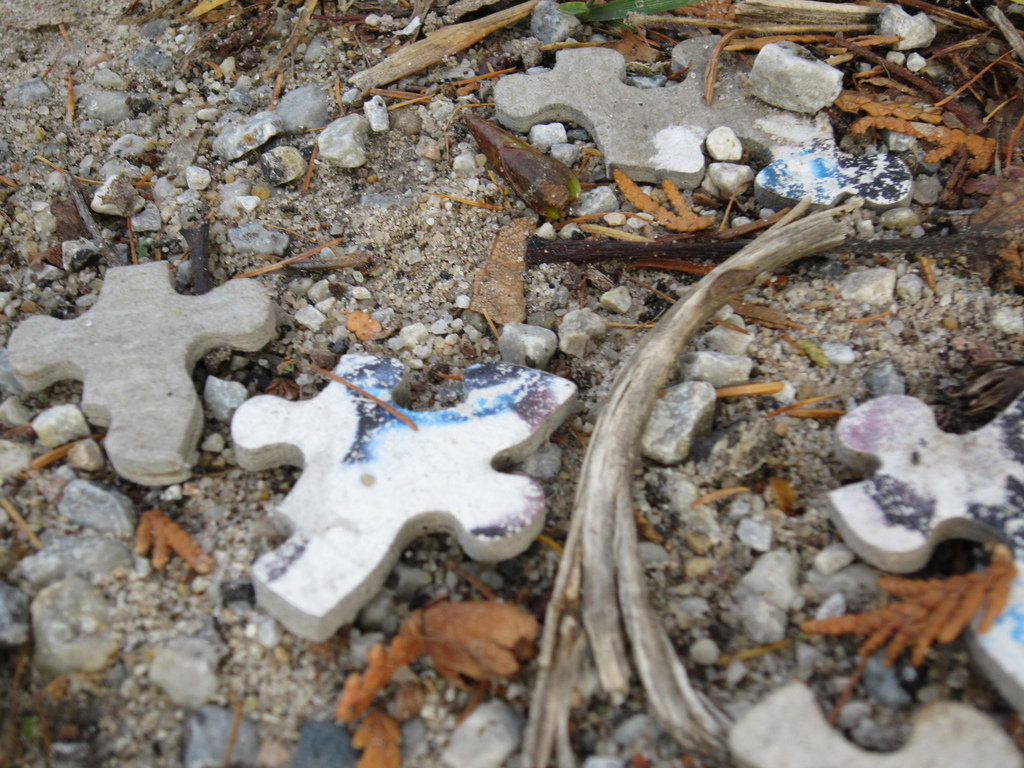
Photo by Flickr user Katerha
While we shake our heads and wring our hands at the continuing decline in enrolment in soils programs as degradation of arable land, climate change, and losses of biodiversity sweep the globe, what is there to be done? I’m hoping to help answer the call of our faltering field: how do we bring in students, and once we’ve got them, train them to meet the demands of future environmental challenges? We need a new kind of soil science professional, a dynamic sort of land manager prepared to work across disciplines and able to communicate their expertise to a broader audience. Perhaps this is the root of the problem; research in soil science rarely reaches the public anymore. In the days of small holder farms and extension work, there existed a clear path for knowledge to flow from the university to the folks that need it. The intrinsic value of land and its connection to our own lives was that much more obvious when more of us were farmers, or knew farmers. This is no longer the case. Yet land use policy decisions must be informed by soil science in order to be sustainable.
These days I do qualitative research. Often when I bring that up, there is the inevitable question of whether I am actually a “soft” scientist, an anthropologist, or a sociologist. While I find these fields fascinating and think they deserve more credit than they often receive, I still consider myself to be a “true” scientist in that I am primarily interested in the phenomena of the natural world, in particular soil. My current approach to studying the challenges related to soil management has taken me right to the source of the disturbance: humans.
It is easy to dismiss the unfamiliar as unimportant. Yet as scientists, one commonality that holds us together is a commitment to critical thinking. Rather than discarding a research method that does not fit in with previous experience, why not take a moment to consider the potential for qualitative and quantitative research to work together?
Much of the work done by pioneering soil scientists does not fit into the scientific ideal of the hypothetical deductive model. Soil description is a process of rich inference; no one has ten thousand years to test a theory of soil formation through experimentation. Statistics play a different role in this field. Yet few would argue against the importance or the validity of this descriptive, essentially qualitative work.
Now, quantitative research has its place. Numbers are elegant, and the ability to describe a treatment such as fertilizer with a tangible value by measuring crop response supported with statistics is a grand thing indeed. It allows us to make informed management decisions. Yet even these kinds of studies are surprisingly complex; one must factor in all variables such as climate, crop, soil type, and any possible interactions. The only way to eliminate these uncertainties is to use a laboratory environment, which doesn’t really tell us that much about how the fertilizer preforms in the field does it?
The complexity of out current global challenges demands that we reconsider our approach, that we learn to integrate and not segregate our knowledge. What is necessary is that the researcher describes their process, allowing the reader to decide how they will use the conclusions provided.
Qualitative research enables me to work in situ and provide a close reflection of occurrences I’ve observed in the learning environment. My research provides one story within the many possible narratives that can be told to describe how we learn about soil when we work together to solve complex problems.
 Soil in the City