It is clear that our current food production system is not sustainable. The good news is that we have a choice in how we will move forward. When I see innovative ideas that are based on the same faulty principles that got us to where we are in the first place, I have to shake my head. Lately there’s been a lot of push towards growing food in small spaces, making use of the vertical dimension, and as one thing leads to another, yet another design for a soilless system relying on artificial lights, constant monitoring, and constructed growing structures is put forth as a sustainable alternative. There are all sorts of questions around the social equitability and barriers to access of such production systems, but for now I’m going to focus on the ecological considerations.
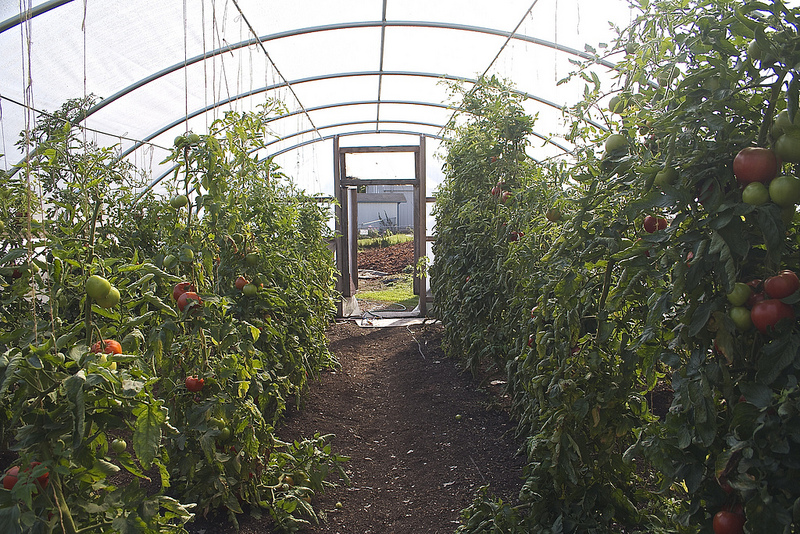
Photo by Flickr user elias_daniel
Making use of vertical space and planning smart aren’t the problem, farmers have grown tomatoes and cucumbers vertically for centuries. Growing food in inert, soilless mediums using hydroponics, artificial lights, and mechanically rotating beds is something different. Hydroponics is nothing new, but the greenwashing of these new urban systems, such as a recent rooftop “farm” in Vancouver is what really gets me. One of the justifications of this method is the decreasing quantity of farmland, something that we should not have to worry about in a province with an Agricultural Land Reserve. Despite the claims that this ultra intensive growing method is sustainable, did you know that COABC does not consider hydroponics to be an organic growing system (Section 7.5.1)?
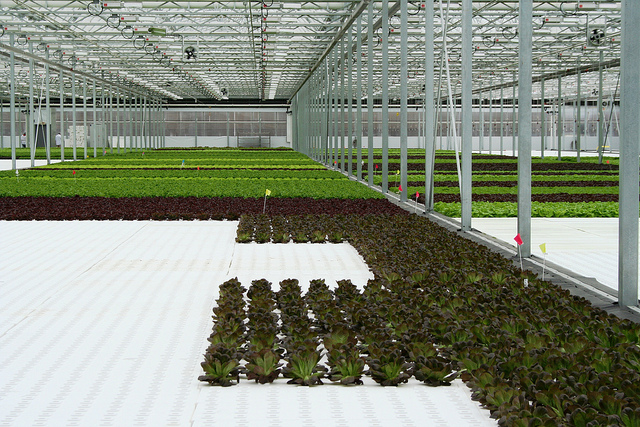
Photo by Flickr user MMW Horticulture Group
Frankly, I’d rather see a tractor ploughing a poorly drained field before I would stand behind a system which relies on plastics and abandons the principles of nature. Not nature as an abstract concept, not nature as a “being”, but nature as the complex system of patterns that evolved over hundreds of millions of years. It seems to be that the further we get away from using these patterns in our food production systems, the larger our troubles become. Natural systems favour diversity and redundancy and in this way they are resilient. While competition is clearly visible, so are beneficial interactions, in ways that we are now only just discovering. The soil, as the medium supporting all this plant, microbial, and insect interaction, is an essential element. Take away the soil and you’ve removed thousands of species of microbes. Take away the soil and you lose the ability to cycle nutrients. Take away the soil and your system can no longer serve as a means of carbon sequestration.

Photo by Flickr user Peter Blanchard
As enticing as some of the fancy new models for producing food in vertically stacked, soilless trays might be, it’s important to ask if this is in fact an improvement. With so many possible alternatives to move forward on, it is not so much a lack of ideas that worries me as a lack of critical thinking. Who is benefiting from this technology? Is there a better alternative? We know that we currently produce more than enough food to feed the world, nearly all of which is grown in the ground. What if we stopped wasting food? What if we stopped turning agricultural land into urban sprawl or oil and gas extraction? What if we changed how and what we ate? These small and slow solutions are indeed less glamorous than the shiny new rooftop greenhouses that are popping up producing organic salad greens for high end grocers. It’s time to start thinking critically about what our options are before we adopt a system that may not be sustainable into the future.
 Soil in the City
I think it’s great that you question these new methods of growing crops, for example, using soil vs. a system such as hydroponics. I would suggest, however, that these alternative systems may be seeking to return land back to nature, and contain our food production system within the ‘human ecosystem’ (i.e. within structures that we have built). There is nothing ‘natural’ about intensive/dedicated agriculture, unless you are making an argument for permaculture or gorilla gardening.
Erfan, you’ve probably guessed that I’ve got a personal bias towards permaculture, and have done my share of guerrilla gardening and seed bombing empty lots. Transforming our entire food production system into that method would be a long term undertaking and really mean transforming other elements of our society as well. I certainly think there are ways to grow food that are more ecologically informed than what we’re doing now. Even simple things that can be integrated into conventional systems to ease the transition for farmers as we are forced to move away from fossil fuel intensive agriculture. Relay cropping is a great example; there’s evidence showing it reduces winter leaching of N and runoff of P enriched topsoil, and it allows farmers to keep up their high production. By enhancing organic matter content in soil, relay cropping starts to build a system of natural abundance where nutrients such as N are slowly released from decaying plant matter left from the winter cover crop. So I suppose I’m saying that we as a society (and particularly we as academics) need to put more effort into transitional processes that slowly move away from our unsustainable practices, rather than expecting farmers to make radical changes over night. Bringing it back to permaculture, we can introduce small and slow solutions by designing from patterns to details.